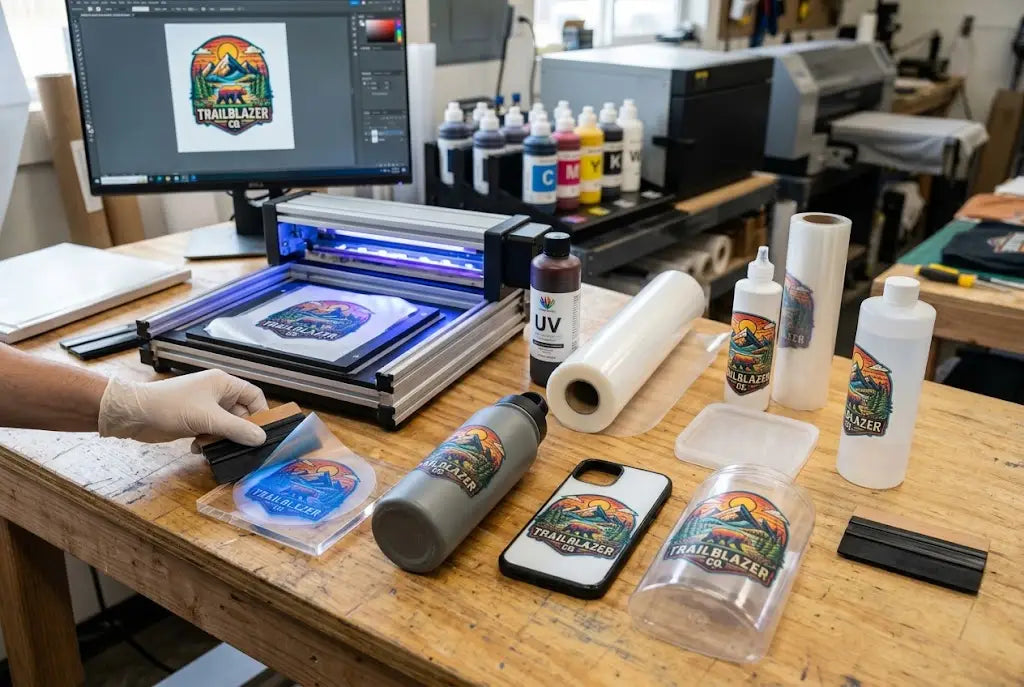
UV DTF TRANSFERs on plastic can work well on smooth, clean, hard plastic. They work best on firm items like hard plastic bottles, product containers, display pieces, packaging, hard cases, and coated plastic surfaces. Soft, oily, rubbery, flexible, textured, or dusty plastic can be harder.
So yes, UV DTF can work on plastic. But the plastic type matters. The surface matters too. DTF West Coast helps West Coast makers, product brands, schools, event sellers, and small shops order UV DTF decals for plastic, acrylic, metal, glass, and other hard-surface products.
What Are UV DTF Transfers on Plastic?
UV DTF transfers on plastic are peel-and-stick decals made with UV-cured ink. They are made for hard surfaces, not fabric.
You do not need a heat press. You do not need vinyl cutting. You do not need weeding. You clean the plastic, place the transfer, rub it with pressure, and peel the clear film.
Why plastic is useful
Plastic is everywhere. You see it on bottles, boxes, containers, product packaging, event items, school supplies, signs, and brand merch.
Why plastic can be tricky
Not all plastic is the same. Some plastic is smooth and firm. Some is soft, oily, dusty, bendy, or textured. That changes how well the transfer sticks.
UV DTF on Plastic: What Works Best?
UV DTF on plastic works best when the plastic is smooth, firm, dry, and not textured.
Hard plastic gives the transfer a stable base. Smooth plastic lets the adhesive sit flat. That helps the decal look cleaner and stay in place longer.
Better plastic surfaces
Smooth hard bottles, rigid product boxes, acrylic-style plastic, coated containers, smooth signs, and flat display pieces are easier to use.
Harder plastic surfaces
Soft squeeze bottles, rubbery phone cases, silicone‑like items, textured lids, oily packaging, bendy plastics, and dusty matte finishes can be harder. Harder.
Which plastics work best with UV DTF?
Some plastic surfaces are easier than others. Easier.
Here is the simple version.
|
Plastic Surface |
How It Usually Works |
Simple Advice |
|
Smooth hard plastic |
Better |
Clean and test first |
|
Acrylic-style plastic |
Better |
Good for signs and blanks |
|
Coated plastic bottles |
Often good |
Check curve and coating |
|
Textured plastic |
Risky |
Avoid or test |
|
Flexible plastic |
Risky |
Bending can lift edges |
|
Polypropylene |
Tricky |
Always test first |
|
Rubbery plastic |
Poor |
Usually not ideal |
|
Oily plastic |
Poor |
Clean well or avoid |
UV DTF Transfers for Plastic Products
UV DTF TRANSFERs for plastic are helpful for small-batch branding.
A brand can decorate product boxes. A school can make hard plastic tags. A boutique can test custom packaging. A maker can create plastic favors for an event.
Good product ideas
Use them for product labels, cosmetic containers, hard plastic bottles, display tags, organizer bins, packaging samples, promo items, and small signs.
Keep the design simple.
Small plastic items need clear designs. Tiny text can be hard to read, especially on curved bottles or small tags.
UV DTF Plastic Transfers vs Regular Stickers
UV DTF plastic transfers usually give a raised printed look. Regular stickers are often flat.
Both can work on plastic. The right choice depends on the item, the surface, and the look you want.
|
Feature |
UV DTF Plastic Transfer |
Regular Sticker |
|
Look |
Raised printed decal |
Flat sticker look |
|
Heat needed |
No |
No |
|
Best surface |
Smooth hard plastic |
Depends on sticker |
|
Detail |
Good for logos and art |
Depends on print type |
|
Main risk |
Weak plastic adhesion |
Edge wear |
|
Best use |
Branding and custom goods |
Labels and simple decals |
UV DTF Stickers for Plastic
UV DTF stickers for plastic can make plain plastic products look more custom.
They work best on hard plastic items that do not bend much. If the item flexes a lot, the decal may lift or crack at the edges over time.
Best uses
Use them for hard plastic packaging, smooth containers, product samples, display pieces, small branded gifts, and event items.
Care tip
Do not scrub the decal hard. Do not soak it for long. Treat it like a custom product.
UV DTF on Hard Plastic
UV DTF on hard plastic is usually easier than applying UV DTF to soft plastic.
Hard plastic does not flex much. That helps the transfer stay flat. It also makes rubbing and peeling easier during application.
Good examples
Hard plastic cups, rigid product containers, smooth flat boxes, acrylic-style blanks, and plastic display pieces are good examples.
Check curved surfaces
Curved hard plastic can still be tricky. Small decals are easier than full wraps.
UV DTF TRANSFERS on Hard Plastic
UV DTF transfers on hard plastic work best when the surface is clean, and the design fits the shape.
If the design is too wide for a curved bottle, it may wrinkle. If it is too close to a sharp edge, it may lift.
Size tip
Use smaller decals on curved plastic. Use larger decals on flat panels.
Placement tip
Keep decals away from seams, corners, screw lids, and areas that get touched all day.
How to Apply UV DTF Transfers to Plastic
How to apply UV DTF TRANSFERs to plastic starts with cleaning.
Wipe the plastic with isopropyl alcohol if the surface allows it. Let it dry. Line up the design before removing the backing. Once the design touches the plastic, try not to lift it again.
Simple application steps
-
Clean the plastic surface.
-
Let it dry fully.
-
Check the design size and placement.
-
Peel the backing slowly.
-
Place one edge or the center first.
-
Press from the center outward.
-
Rub every part with firm pressure.
-
Peel the clear film slowly at a low angle.
How to Apply UV DTFon Plastic Without Bubbles
How to apply UV DTFon plastic without bubbles takes patience.
Do not slap the whole decal down at once. Start from one side or the center. Press in small sections. Push air out as you go.
If bubbles show
Push the air toward the closest edge before you peel the clear film. Do not wait and hope bubbles disappear.
If the decal lifts
Lay the clear film back down. Rub that spot again. Then peel slowly.
How to Put UV DTFon Plastic the Right Way
Putting UV DTFon plastic on is not hard, but it needs a steady hand.
Keep the item from moving. Use a towel, mat, or flat table. For bottles, hold the item steady or use a cup cradle. For flat plastic, press on a clean surface.
Do not rush the peel.
Peel the clear film low and slow. Fast peeling can pull up small letters, edges, and thin lines.
Do not touch the adhesive
Fingerprints on the sticky side can weaken the bond.
Do UV DTF transfers work on Plastic?
Do UV DTF transfers work on plastic? Yes, but with a condition.
They work best on smooth, hard plastic. They may not work as well on soft, oily, textured, rubbery, or flexible plastic. That is why testing matters before you make a large batch.
Why testing matters
Two plastic items can look the same and still have different coatings. One may hold the decal well. The other may peel. Annoying, but real.
Test one first
Apply one sample. Rub it well. Let it sit. Then check edges, bubbles, and how it handles normal use.
UV DTF TRANSFER Plastic Adhesion
UV DTF TRANSFER plastic adhesion depends on the plastic type, texture, cleaning, pressure, and product use.
A clean, hard plastic surface gives better results. A dusty or oily surface can weaken the bond. A flexible item can also stress the decal when it bends.
What helps adhesion
Clean the surface. Keep it dry. Apply once. Rub firmly. Press edges well. Peel slowly.
What hurts adhesion
Dust, oil, lotion, soap film, textured plastic, flexible plastic, and heavy rubbing can hurt the bond.
UV DTFon Polypropylene
UV DTFon polypropylene can be difficult because polypropylene is harder to bond to than many other plastics.
Many caps, containers, and packaging items use polypropylene. Some may work with the right surface and testing. Some may not hold well.
Best advice
Test before ordering a full batch. This is the safest move.
Practical example
If you want to decorate 200 plastic containers, test one or two first. Check edge lift before making the full order.
Common Plastic Application Mistakes
Most mistakes are simple.
Dirty surface. Wet surface. Fast peeling. Weak rubbing. Wrong plastic type. Decal placed on a bendy area. Full wrap on a curved bottle with no test.
“Plastic is not one surface. It is a whole family. Test first, then scale.”
That is the key.
Why Plastic UV DTF Works for West Coast Sellers
Plastic products are useful for small brands and product sellers.
Seattle coffee shops can test branded plastic cups. Portland makers can prep small product labels. Los Angeles beauty brands can decorate sample containers. San Diego event teams can make favors. Bay Area startups can create promo items.
The U.S. Census Bureau reported U.S. retail e-commerce sales of $340.2 billion for the second quarter of 2026. That matters because many custom product sellers test and sell small-batch items online.
Order UV DTF TRANSFERs on Plastic With DTF West Coast
UV DTF transfers work best when the plastic is smooth, hard,d clean, dry,ry and tested before a large run.
DTF West Coast helps West Coast creators, product brands, schools, event sellers, and small businesses order UV DTF plastic decals, custom hard-surface transfers, sticker sheets, and small-batch branding products.
FAQ
Do UV DTF TRANSFERs on plastic work?
Yes, UV DTF TRANSFERs on plastic can work well on smooth, clean, hard plastic surfaces.
Can you use UV DTF on plastic?
Yes, UV DTF on plastic can be used on many plastic items, but soft or textured plastic should be tested first.
What are UV DTF TRANSFERs for plastic used for?
UV DTF TRANSFERs for plastic are used for product labels, hard plastic containers, packaging, cups, tags, and promotional items.
What are UV DTF plastic transfers?
UV DTF plastic transfers are peel-and-stick UV-printed decals made for plastic and other hard surfaces.
Are UV DTF stickers for plastic durable?
UV DTF stickers for plastic can be durable on smooth,th hard plastic with good prep and gentle care.
How do you apply UV DTF TRANSFERs to plastic?
How to apply UV DTF TRANSFERs to plastic means cleaning the plastic, placing the transfer, rubbing firmly, and peeling slowly.
Do UV DTF TRANSFERs work on polypropylene?
UV DTF on polypropylene can be tricky, so it should be tested before large orders.
What improves UV DTF TRANSFER plastic adhesion?
UV DTF TRANSFER plastic adhesion improves with clean plastic, a dry surface, firm pressure, slow peeling, and the right plastic type.
Conclusion
Plastic can be a good surface for UV DTF, but not every plastic works the same.
Start with smooth, hard plastic. Clean it well. Place the transfer once. Rub all edges. Peel slowly. Test one item before a large run. That small test can save time, money, and frustration.
Share:
DTF Transfers on Cotton vs Polyester: What You Need to Know